

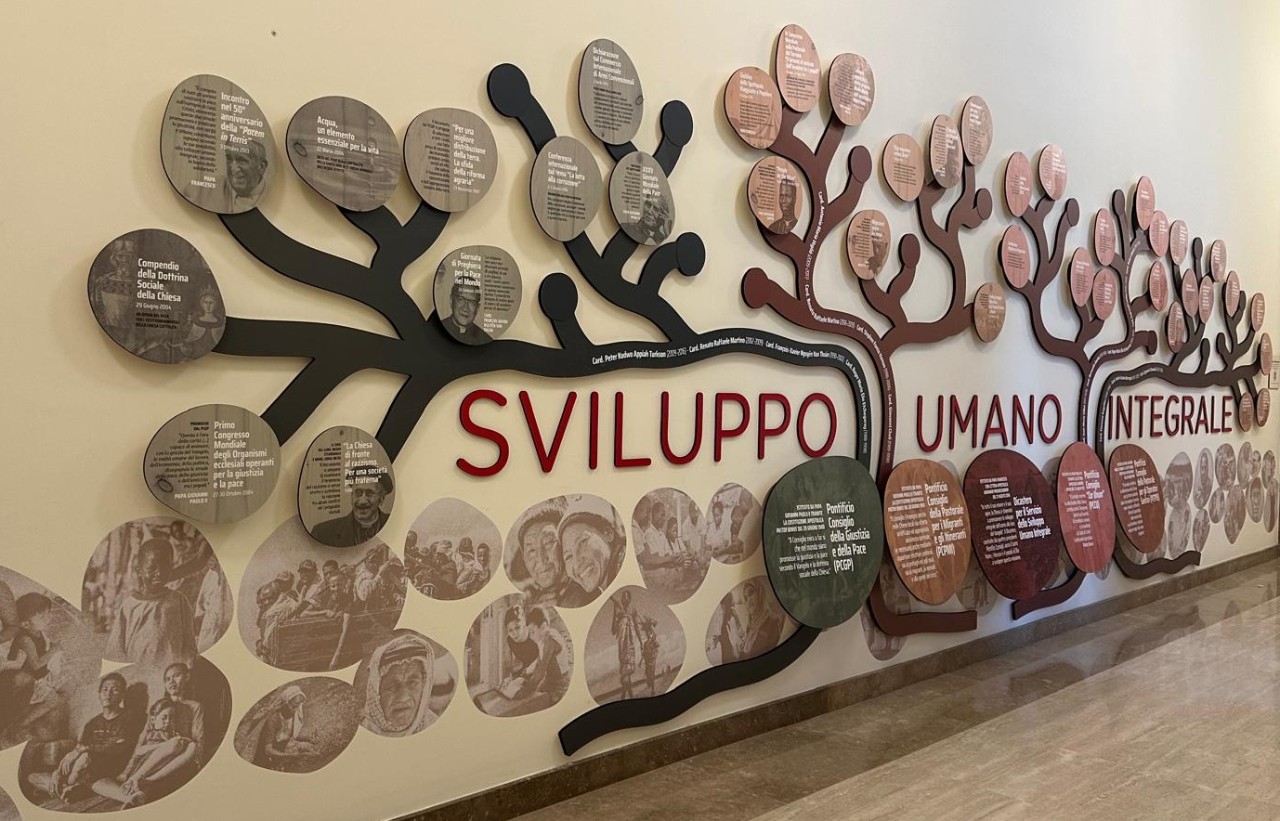
Visitors to the Dicastery for Promoting Integral Human Development (DPIHD) will encounter a nine-meter-long and nearly three-meter-high installation entitled “The tree of human dignity” as they walk through the corridors.
The installation was inaugurated by Pope Leo XIV during his visit to the Dicastery on October 9, 2025, the day of the publication of the Apostolic Exhortation Dilexi te. The Holy Father paused before the work, together with the Superiors and Officials, for a prayer and a blessing for all those who faithfully carry forward the mission of the Dicastery, in service to humanity throughout the world.
The purpose of the work is to represent the continuity between the past and the present. The past merges with the present. The DPIHD was established on January 1, 2017, from the merger of four previous Pontifical Councils: Cor Unum, Justice and Peace, Migrants and Itinerant People, and Health Care Workers, from which it inherited the various issues addressed and its mission: to promote the human dignity of all individuals, without exception, with particular attention to the weakest, the least, and the excluded.
The final effect is the image of a large tree. Every Pontifical Council represents one of the roots from which the Dicastery originates and develops. The roots are solid, while the branches and leaves represent growth towards a more dignified future. The names of the various Prefects who have guided and inspired the work of the four Pontifical Councils are inscribed on the tree trunks, while the leaves are represented by panels depicting the main events and initiatives of the various offices.
In the background, a cobblestone pavement of faces from different realities, places, and ages, representing the humanity that the Dicastery wishes to serve, forms a road that reminds us of a Church that is outgoing and on the move.
The work is made almost entirely of wood, treated with ecological substances that guarantee its durability over time. The colors refer to nature and the world of plants. The intent is to reposition the activity carried out by this office on the planet we inhabit and with which we are called to live in symbiosis. The concept and design are by Kaleidon, while the realization is the work of Mela-P.


